Discraft Nuke Review: Maximum Distance Driver for Power Throwers
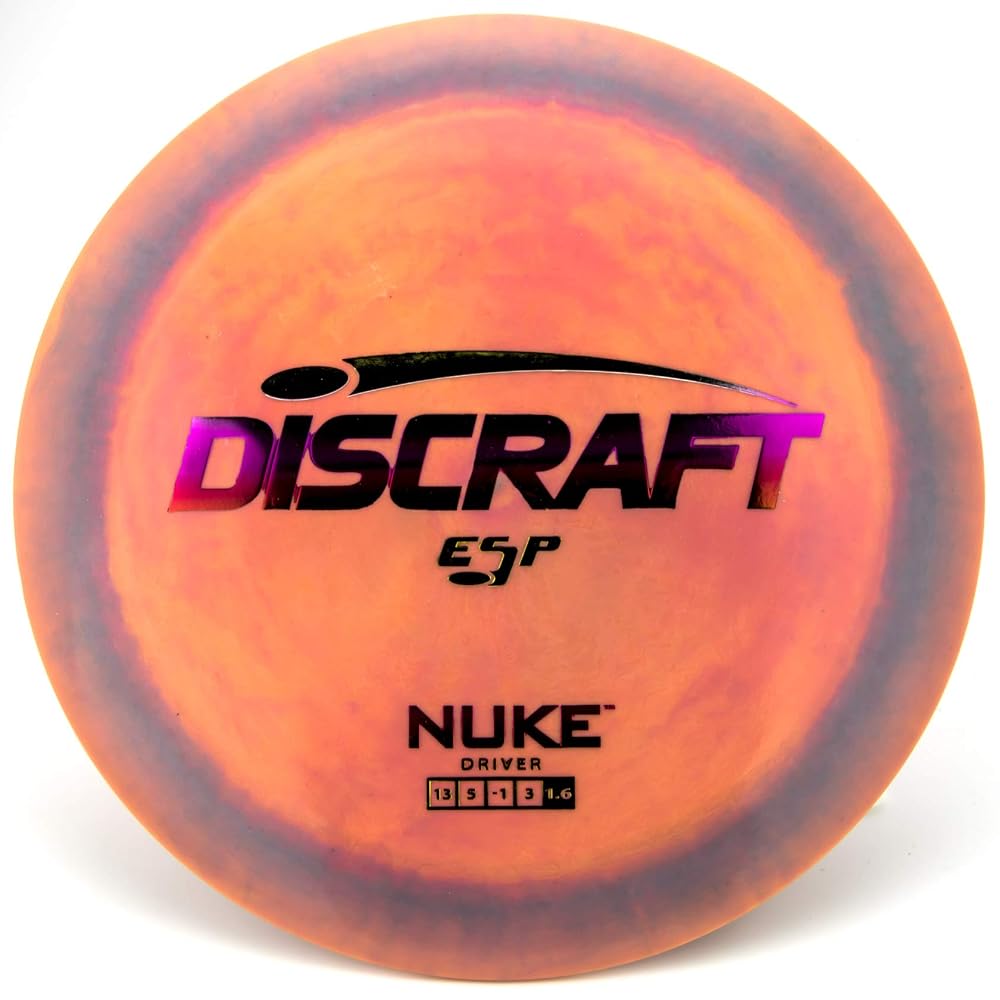
The Discraft Nuke is one of the most popular maximum-distance drivers ever made. At Speed 13 - one of the highest speed ratings available - it is built for players who generate enough arm speed to reach its flight window. When thrown properly, the Nuke's 13/5/-1/3 numbers produce a long, controlled S-curve with impressive distance. When thrown too slowly, it behaves like a very overstable disc that fades hard and goes nowhere. Knowing the difference is the key to deciding if the Nuke is right for you.
Discraft Nuke - Quick Specs
- Flight Numbers 13 / 5 / -1 / 3 (Speed / Glide / Turn / Fade)
- Disc Type Distance Driver (Max Speed)
- Stability Slight understability at very high speed; overstable finish
- Weight Range 155g-175g (power throwers use 170-175g)
- Plastics ESP, Z Line, Big Z, Titanium, ESP FLX, CryZtal
- Approx. Price $18-25 depending on plastic
- Best For Advanced players; absolute maximum distance in good conditions
Who Should Throw the Discraft Nuke?
The Nuke's Speed 13 requires the most arm speed of any disc in this review series. Disc golf coaches typically recommend at least 65 mph throwing speed before adding a Speed 13 driver, which roughly translates to throwing other fairway drivers 300+ feet consistently.
- Beginners and casual players: Do not buy the Nuke as your first or second disc. It will disappoint you. The disc needs to be moving extremely fast to reach its intended flight characteristics - at slower speeds it fades out early and goes nowhere.
- Intermediate players (300-380 feet): The Nuke may start working, but most players in this range will find the Zeus (Speed 12) or Destroyer (Speed 12) easier to control and nearly as far. Save the Nuke for when your arm speed demands it.
- Advanced players (400+ feet): The Nuke delivers. Players with high arm speed appreciate its extra speed over Speed 12 drivers for maximum open-field distance. It also handles power throws without turning over where a Speed 12 might flip.
How the Discraft Nuke Flies
At the arm speed it requires, the Nuke produces a long flight with a slight rightward turn in the high-speed phase (Turn -1), followed by a reliable Fade 3 finish. The Glide 5 keeps it airborne through both phases. The result is maximum distance with a predictable landing zone on the left side of its flight path.
Thrown with extra power, the Nuke remains more stable than Speed 12 discs - its higher speed rating means it handles power without flipping. For players who have "powered out" of their Zeus or Destroyer (throwing so hard the disc turns over), the Nuke is the natural next step.
The Nuke SS (Super Stable/understable version) and Nuke OS (Overstable version) are different discs. The standard Nuke reviewed here is the baseline - the most popular version and the one most players mean when they say "the Nuke."
Discraft Nuke Plastics Compared
- ESP: The standard Nuke. Grippy, durable, consistent. This is the version most players buy first and return to repeatedly. Around $20-22.
- Z Line: Stiffer than ESP. Slightly more overstable due to stiffness. Good for headwind conditions when you want the Nuke to fade more reliably.
- Big Z: More flexible than ESP. Slightly more understable, excellent in cold weather. Good for players who want the Nuke to turn a touch more.
- Titanium: Very durable, distinct feel. Flies similar to ESP but with a different texture. Tour-player favorite for specialty runs.
- ESP FLX: Flexible ESP. Best grip in rain and cold. Very similar flight to standard ESP.
Pros
- Maximum distance for players with high arm speed
- Handles power throws without turning over
- Reliable Fade 3 finish for shot planning
- Wide plastic selection in every Discraft blend
- One of the most popular distance drivers in the world
Cons
- Requires the most arm speed of any disc reviewed here
- Very disappointing at lower arm speeds
- Not significantly better than Speed 12 discs for most recreational players
Nuke vs Zeus vs Destroyer
These three discs occupy the top of the distance driver market. Key differences:
- Nuke (13/5/-1/3): Highest speed, best for maximum arm speed throwers. Handles power without flipping where Zeus/Destroyer might turn over.
- Zeus (12/5/-1/3): One speed class lower. More accessible, easier to control at high-intermediate arm speeds. Paul McBeth's signature.
- Destroyer (12/5/-1/3): Identical numbers to Zeus, different brand/plastic/rim feel. Choose Zeus or Destroyer by feel; choose Nuke when you need Speed 13.
Frequently Asked Questions
What is the difference between the Nuke and Nuke SS?
The standard Nuke (13/5/-1/3) is slightly understable at high speeds and fades reliably. The Nuke SS (Super Stable or Super Speed, depending on the version) is more understable - it turns more and finishes flatter. The SS is designed for developing players who want Nuke-speed distance with less fade. Most advanced players prefer the standard Nuke for reliability.
Should I throw the Nuke or the Zeus?
For most players, the Zeus (Speed 12) is the better choice. It produces nearly identical distance at lower arm speeds and is easier to control. Only move to the Nuke if you are consistently throwing the Zeus 400+ feet and finding that it turns over at max power - that signals you need the extra speed of a Speed 13 driver.
What weight Nuke should I throw?
Power throwers should throw 170-175g for maximum distance - heavier weights are more stable and handle high arm speeds better. Players in the 350-400 foot range may get better results with 160-165g, as the lighter weight gives the Nuke slightly more understability and makes it easier to get airborne.