Discraft Buzzz Review: The Best Midrange in Disc Golf
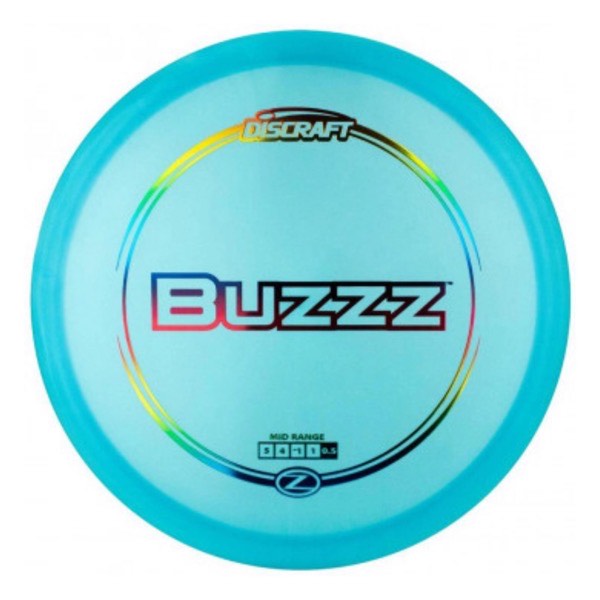
Ask any group of disc golfers what midrange they'd keep if they could only keep one, and the Discraft Buzzz comes up more than any other answer. It has been the best-selling midrange disc in the sport for over two decades, and for good reason: it flies straight, holds whatever line you put it on, and works at every skill level from beginner to professional. Paul McBeth, Nate Sexton, and countless other PDGA professionals have thrown it at major tournaments. Weekend players reach for it on every other hole.
This review covers the Buzzz's flight in detail - what those 5/4/-1/1 flight numbers actually feel like on the course, which plastics to buy, and whether it belongs in your bag at your current skill level.
Discraft Buzzz - Quick Specs
- Flight Numbers 5 / 4 / -1 / 1 (Speed / Glide / Turn / Fade)
- Disc Type Midrange
- Stability Neutral (slight understable at lower speeds)
- Weight Range 140g-180g (most players throw 170-177g)
- Plastics Z, Z FLX, ESP, Big Z, Cryztal Z, Jawbreaker Z, Putter Line
- Approx. Price $14-25 depending on plastic
- Best For All skill levels; workhorse midrange for any bag
Who Should Throw the Discraft Buzzz?
Almost everyone. That's the honest answer, and it's what makes the Buzzz unusual among disc golf discs - most discs have a clear target skill level, but the Buzzz genuinely performs differently at different arm speeds in ways that work for the thrower.
- Beginners: At lower arm speeds, the Buzzz flies slightly understable - a gentle right turn with minimal fade. This makes it forgiving for new players still developing a flat, consistent release. It won't fade out hard on you.
- Intermediate players: At moderate arm speeds, it flies almost perfectly straight with a gentle left finish. This is its "intended" flight and the profile most people associate with the Buzzz.
- Advanced players: At high arm speeds, the Buzzz becomes more overstable and handles shots that require a reliable fade. It can be thrown hyzer-flip for a straight line or on full power for a straight-to-fade approach.
The one player who should probably look elsewhere: someone who needs maximum distance from their midrange. The Buzzz is accurate and workable, not a long-bomber. For that, a faster midrange like the Innova Roc3 or a fairway driver like the Innova Leopard3 makes more sense.
How the Discraft Buzzz Flies
The Buzzz flight numbers (5/4/-1/1) describe a neutral midrange: moderate speed, solid glide, slight high-speed turn, and a gentle fade at the end. In the air, this translates to a disc that launches straight and stays straight for most of its flight, then finishes with a soft left hook.
On a hyzer release (disc tilted to the left), the Buzzz holds the angle longer than most midranges before flattening out. On an anhyzer (disc tilted right), it holds that line and glides out to the right. This "holds lines" quality is the Buzzz's signature characteristic and why players trust it in tight situations where they can't afford a surprise curve.
In the wind, the Buzzz performs well for a midrange: the slight understability helps it stay aloft in tailwinds, while its moderate fade keeps it from flipping in moderate headwinds. It's not a headwind specialist like a dedicated overstable disc, but it handles typical course conditions reliably. For a full breakdown of how stability affects wind performance, see the overstable vs understable guide.
Discraft Buzzz Plastic Types Compared
Discraft makes the Buzzz in more plastic blends than almost any other disc. Here's how the most common ones differ:
- Z Plastic: The standard. Hard, slick, durable, and consistent. Most players' first Buzzz. Flies neutral, beats in gradually over time. Around $15.
- Z FLX: Flexible Z plastic - similar flight but more comfortable in cold weather and doesn't snap out of your hand as easily in wet conditions.
- ESP: Discraft's premium plastic. Grippier than Z, more durable, and slightly more understable at the same weight. Most tour players throw ESP. Around $20-22.
- Jawbreaker Z: Very soft, almost rubbery feel. Excellent for putting approaches where you want the disc to "stop" rather than skip forward. Most understable of the Buzzz lineup.
- Cryztal Z / Big Z: Translucent plastics with slightly different feel. Big Z is more flexible and understable; Cryztal is stiffer. Specialty buys for players who already know the Buzzz well.
Recommendation: start with Z plastic. It's the most neutral and the most predictable across conditions. Once you know how the Buzzz flies for your arm speed, the ESP is a great upgrade.
Pros
- Holds any line reliably - straight, hyzer, anhyzer
- Works for all skill levels and arm speeds
- Wide plastic selection for any conditions
- Extremely consistent mold - every Buzzz flies the same
- Used by PDGA professionals at the highest level
Cons
- Not a distance disc - purpose-built for accuracy
- So common it can feel "boring" to new players chasing hype
- Premium plastics run $20+ and may feel unnecessary to beginners
Similar Discs to Consider
If the Buzzz isn't quite right for what you need, here are the closest alternatives:
- Innova Teebird - If you want more distance than a midrange and are ready to step up to a fairway driver with reliable, straight flight.
- Innova Leopard3 - More understable fairway driver for beginners who want extra distance. Not a midrange, but often fills the same "workhorse" role early in your disc golf career.
- Innova Roc3 - Overstable counterpart to the Buzzz (5/4/0/3). Good next step once your arm speed develops and you want a midrange that holds harder lines in the wind. See the full Buzzz vs Roc3 comparison.
Frequently Asked Questions
Is the Discraft Buzzz good for beginners?
Yes. The Buzzz is one of the most beginner-friendly midranges available because its slight understability at lower arm speeds makes it forgiving and intuitive. It won't fade out early the way overstable discs do for new players. That said, a dedicated beginner starter set (which often includes more understable options) may be a better first purchase - see the beginner disc guide.
What weight Buzzz should I get?
Most players do well with 175-177g, which is the standard tournament-weight range for midranges. Lighter weights (160-165g) fly a bit more understable and can add distance for players with lower arm speeds. If you're just starting out, a 175g Z Plastic Buzzz is the safe default.
How does the Buzzz compare to the Buzzz SS?
The Buzzz SS (Super Straight) is more understable than the standard Buzzz - it turns more and finishes flatter. The SS is better for players with lower arm speeds who need extra turn to keep the disc aloft. The standard Buzzz is more neutral and the better long-term choice once your form develops past the very beginner stage.